Grade: B-
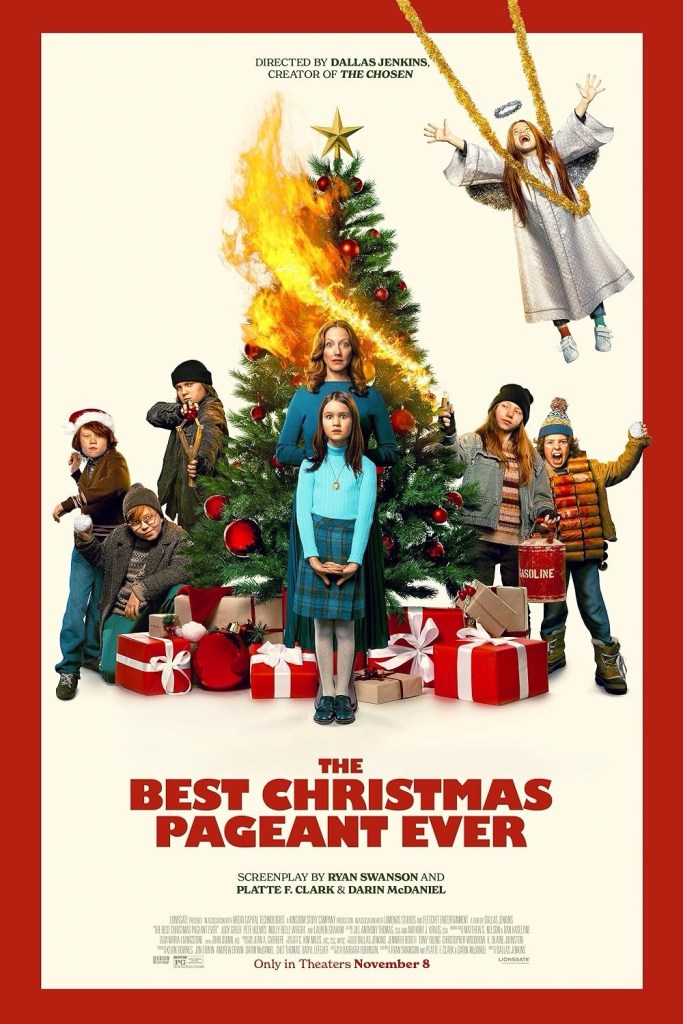
Barbara Robinson’s 1972 novel The Best Christmas Pageant Ever is not based on a true story – yet, amusingly, the 2024 film ends with freeze-frames of certain characters accompanied by biopic-style captions that inform us of what happened to everyone. In my 43 years (33 of them spent in the world of live theatre), I’d managed to dodge all iterations of the Herdman multiverse. I know a play adaptation has been a staple on the boards, building up young resumes and putting many a community theatre’s finances in the black for decades. I had never read it, seen it, or been in it. I had only known OF it, until now, upon my viewing of this movie from Lionsgate and director Dallas Jenkins (The Chosen).
The story takes place in one of those small towns in literary fiction where the population looks to be about 50, everyone knows each other, and all anybody talks about is the annual Sunday School Christmas pageant at the church. In all fairness, this particular year is the pageant’s 75th anniversary, so it is a big deal. Its longtime director has “taken a spill” and broken both legs, and Grace (Judy Greer) agrees to take over. The aforementioned Herdmans are six rambunctious kids who live in a dilapidated house. When I first saw a shot of it, I thought it was abandoned. They cuss out the teachers, steal, commit arson, bully, and are generally a horror for everyone. They show up at church one day because they hear there’s free food there. One thing leads to another, and they end up getting cast in plum roles in the pageant.
The movie is narrated by Lauren Graham as the adult version of Grace’s daughter Beth. Young Beth is played by the wonderful Molly Belle Wright. All the child actors are effective, especially Beatrice Schneider as Imogene Herdman, who gets to play the Virgin Mary, much to the outrage of the girl who had played her for the last few years, who is now reduced to part of the “angel choir.” The adult actors are entertaining as heightened, melodramatic old-time sitcom parents. They lean into every beat with commitment, never appearing embarrassed to be doing what they’re doing how they’re doing it.
In recent years, we’ve had our share of Eat the Rich and Eat the Patriarchy movies. Here, there’s an unexpectedly relevant throughline emerging from this 52-year-old book. You could call it Eat the Karens. It’s an uncracked mirror planted squarely at the uptight, well-to-do soccer/theatre/whatever moms who want things to continue just like they always have, especially if their child is the one in the forefront, reaping the benefits. When they get together and voice their objections to the Herdmans being involved with the pageant, they collectively speak their sentences a few words at a time – taking turns, as if they are parts of the same person. Everybody is convincing in their performances, and there is fun in getting to see their horizons ultimately expanded.
After the conclusion of the pageant, which goes over surprisingly well due to the newness and unpredictability, I wanted more of an exploration of how it made the Herdman kids feel, and how the relationship/dynamic will change with the classmates going forward. Instead, the focus veers away from the Herdmans, and becomes more about how the show is received by the stuffy traditionalist townspeople. That’s worth showing, too, but I wouldn’t have minded a few more minutes with the kids in the denouement. Either way, this Best Christmas Pageant Ever was a worthy introduction for me, with no cinematic catastrophes. To my eyes, yes, this family could be a handful, sometimes to a destructive and criminal degree – but they’ve also been too easily written off as misfits by those more fortunate. Nobody gave them a chance. I sensed the Herdmans not feeling like they deserved a chance. How can we help a Herdman?
Grade: B-
 Film Reviews by Mark
Leave a comment