Grade: D
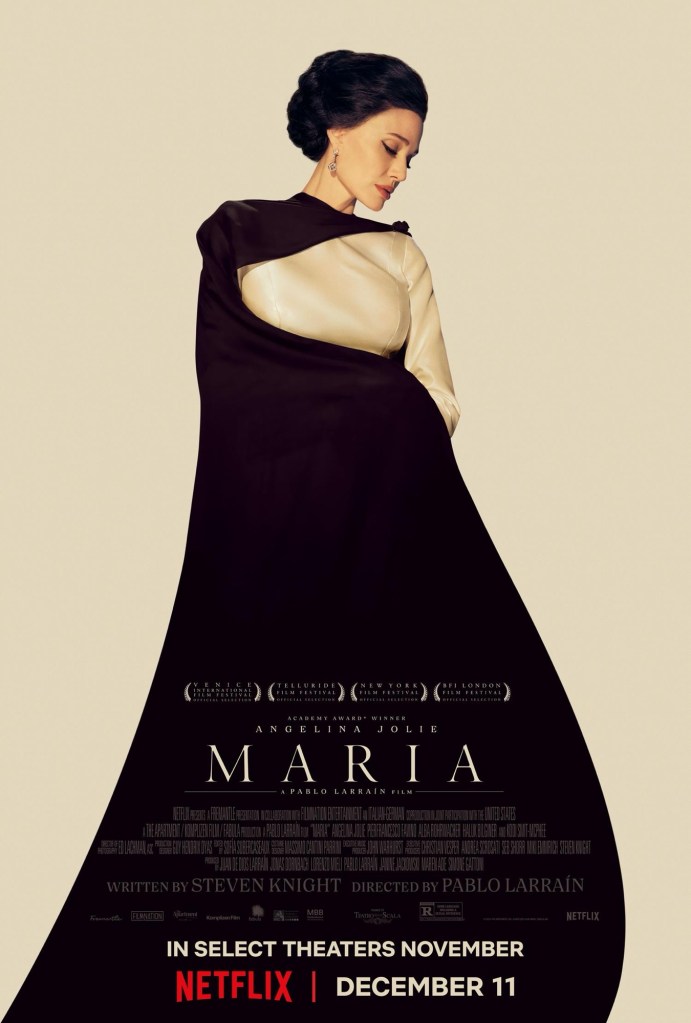
Pablo Larraín previously directed Kristen Stewart and Natalie Portman to Best Actress Oscar nominations, with Spencer and Jackie. His Maria is the third and final film in what he calls the “lady with heels” trilogy (female-led biopics). Angelina Jolie might be headed for the same awards destination as Stewart and Portman, for her work as the title character, renowned opera singer Maria Callas. It’s definitely a Larraín biopic, cut from the same cloth through and through.
In typical Larraín fashion, it’s not a rote, by-the-numbers march through all the major details of someone’s life, capped off with captions that spoon-feed us what ends up happening to everyone. Like Spencer and Jackie before it, Maria is a snapshot of one particular period. It’s an imagined retelling of her final years, when she no longer sang professionally. It’s a one-note dull-as-dishwater affair, available on Netflix for you to turn off so you can go outside and watch grass grow.
Jolie is extremely good here. I routinely forgot it was her, and it felt like I was watching a documentary about Callas. The lip-syncing is questionable, but whatever singing she does do is impressive, and better than what most of us could do. I hear that it’s Callas’s voice during the flashbacks to her professional peak, and in the post-retirement period, it’s Jolie. Larraín doesn’t seem to trust that we’ll remember “when” we are, changing up the color scheme depending on the time frame we’re in. Sometimes we get black-and-white, and what looks like sepia tone.
Callas passed away at age 53, on September 16, 1977. When she died in this movie, I didn’t care or feel a thing. After a minute or two of marveling at the talent it must take to pull off this style of singing, the rest of Pablo Larraín’s Maria is a doleful, drab, boring, slow, downtrodden, uptight chore to sit through. I learned and felt very little. I bet watching it is like if someone who hates opera was dragged to one.
Grade: D
 Film Reviews by Mark
Leave a comment