Grade: A-
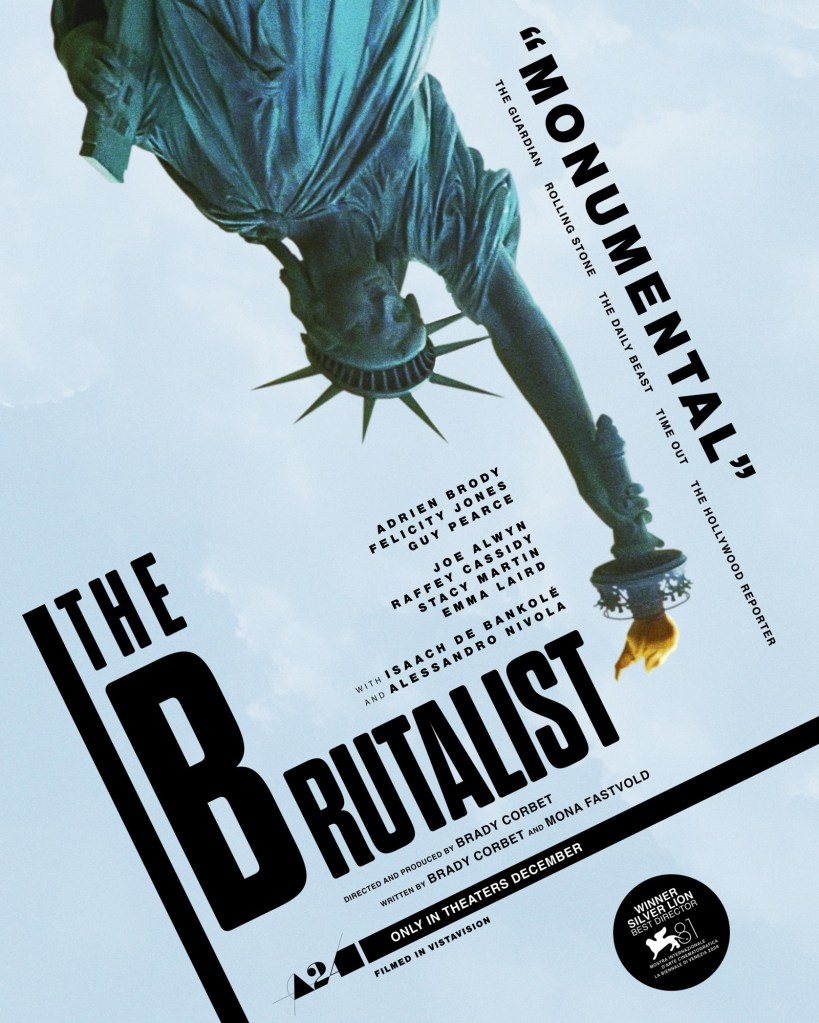
If you’re fortunate enough to see The Brutalist at a theater, as opposed to your home, it’s an experience. At 3 hours and 35 minutes, I’d compare it to an evening out at the theatre. It begins with an overture, and halfway through, there’s a 15 minute intermission built in. So, really, there’s “only” 3 hours and 20 minutes of actual movie. It is a big, ambitious, grand, cinematic epic. I liked it better than Killers of the Flower Moon and even Oppenheimer. I didn’t go into it with excitement; there are so many ways I was afraid it would quickly go south and bore me to tears, but it successfully avoided or side-stepped almost all of them.
We begin in 1947. Adrien Brody stars as László Tóth, a Holocaust survivor from Budapest, forcibly separated from his wife Erszébet (Felicity Jones). When we first meet László, he’s docking at Ellis Island. His American cousin puts him up at his furniture store in Philadelphia, where he helps out. László, a licensed architect, is commissioned to put in shelves for a personal library, as a surprise birthday present for the extremely wealthy Harrison Lee Van Buren Sr (Guy Pearce).
Mr. Van Buren arrives home earlier than expected, and is none too pleased. Some time later, he shows up at László’s place of employment (shoveling coal) to apologize. He was out of sorts because his mother wasn’t well, and sees potential in László. He’d like him to build a sprawling chapel/theater/community center on his property, in honor of his recently deceased mother. He will be housed there, paid handsomely, of course, and his wife is welcome to join him when she makes it into the country. (She does turn up in the second half.)
Director Brady Corbet has constructed something grand, with his movie about the construction of something grand. It was great to see Guy Pearce again, and amid a trio of spectacular performances, his was my favorite. I wonder if he drew inspiration from the great Carter Pewterschmidt of Family Guy; I certainly thought of him. I loved the straightforwardness of the storytelling. For the most part, there is no deception, ulterior motives, hidden symbolism, or various other twists. Everyone means exactly what they say, and you can take everything they do at face value. The score is the best I’ve heard this past year – reminiscent of something John Williams would write for Steven Spielberg in their heydays. I haven’t seen any actor in the film better than they are here. Corbet is utilizing so many filmmaking elements to bring us a movie that somehow soars and feels meaningful. It builds up to a perfectly timed act break, which I couldn’t wait to come back from and continue the journey.
After the intermission, what I call the second act doesn’t quite have the focus of the amazing first half. It goes off on various new subplots and tangents, and by the time we arrive at the epilogue (set in 1980), with the bouncy piano-driven song in Bb that segues into the end credits, it’s easy to forget it’s the same movie with which we started. Maybe a couple of repeat viewings would clean up and clarify things for me. And I would see it again. And I’d be quite happy if this was our Best Picture. I have written “It’s not elegant, upstanding cinema, but…” on a few occasions. The Brutalist IS elegant, upstanding cinema, and it’s one of the best examples of such.
Grade: A-
 Film Reviews by Mark
Leave a comment