Grade: B-
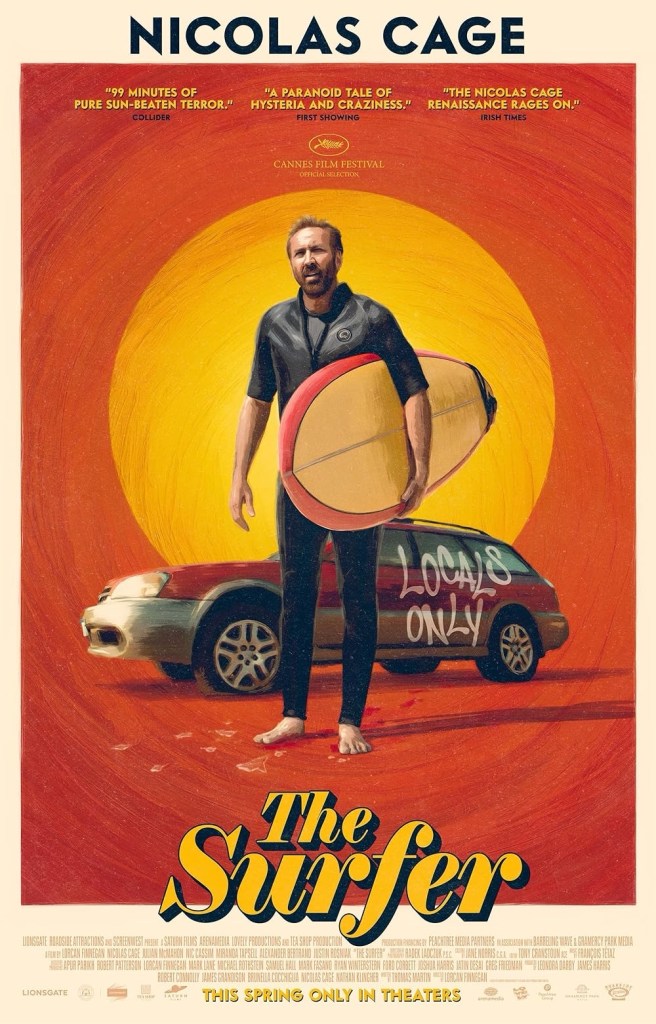
Right off the bat, I want to inform you that The Surfer is my most hesitant “recommend” of the year. I don’t want people to just look at the grade, and rush out to see it. I don’t know how often I’d want to see The Surfer again, if ever. It’s not always enjoyable – in fact, it frequently isn’t – but I left with a mild fascination and curiosity to read discussion on Reddit and the like, to see opinions and interpretations.
It’s another Nicolas Cage vehicle, where he is just about the only big name in the film, and also has a producer credit. He seems to have a movie like this come out every 5 minutes, 400 days a year. It opens with us meeting him, a soon to be divorced dad, taking his teenage son to the beach where he grew up in Australia, to do some surfing. The first scene in the car is an opportunity for Cage to wax philosophical about the art of surfing, and the waves, and all that.
He has a surprise for the boy. It really means more to Cage than anyone else. He plans to buy his childhood home. Plans to. It’s far from set in stone, as we see in his many frantic phone calls about wiring money, “how much can you send,” “would you accept this much right now,” etc. It’s Christmas week, and many people aren’t in the office to take his calls. He and the boy hit the beach with the intention of surfing, and are immediately met with pushback from the belligerent, territorial locals. “Don’t live here, don’t surf here.” The son is hot, bored, and wants to leave, so Cage takes him back, then returns to the beach alone, on a mission.
Director Lorcan Finnegan utilizes several filmmaking elements to successfully give us a trapped, fish-out-of-water (almost literally) story. My favorite movie review podcast mentioned The Royal Hotel in their list of comparisons, and I can see that – but one they didn’t name that especially came to mind was Oliver Stone’s U Turn. In it, Sean Penn gets stuck in a small town where it’s obvious to seemingly everybody that he’s “not from around here.” He is put through the wringer, being met with setback after setback. Both The Surfer and U Turn have camera work that really leans into the sweltering heat. Both scores have a spaghetti western feel, and fixate on unflattering closeups of scorpions, snakes, and drooling barking dogs. Cage’s car disappears. People tell him that he never had that car. When he sees they have his surfboard and his watch (that he uses as attempted payment for a cup of coffee), they tell him it belongs to them, and they’ve had it for years. He is tired, hungry, dehydrated, and questions his reality.
It spends a significant chunk of its runtime living in the doldrums, without progressing. When I eventually thought we got everything it was going to give us, a much-welcomed third act development provides some newness and context. It isn’t all aimless, indecipherable symbolism. There’s an explanation for everything, and I liked it better than some of M. Night Shyamalan’s twists. It’s a life vest or a buoy for a movie that was drowning, and would have otherwise. You will definitely wonder how worth it the outcome is, and what it will cost, but it was refreshing to finally see it pose those kinds of questions. He did just want to go surfing, after all.
Grade: B-
 Film Reviews by Mark
Leave a comment