Grade: A
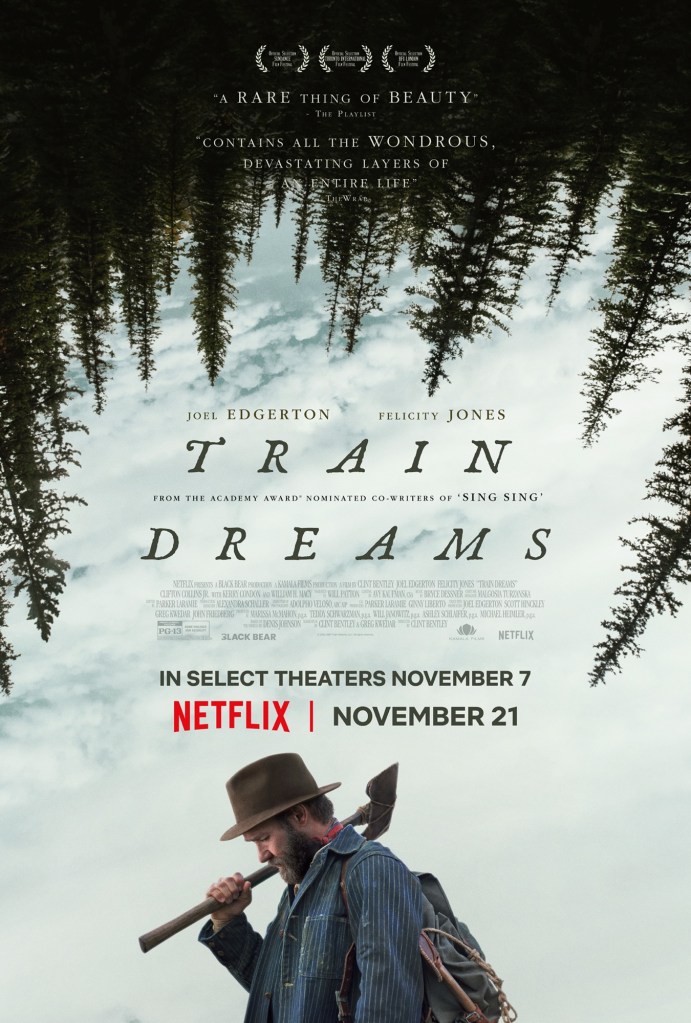
If the feature-length character study of a person’s life, from birth to death, starts becoming a genre or recurring pattern, I can imagine it quickly wearing thin. This year, the concept was executed as beautifully as I may ever see it done – twice – with The Life of Chuck, and now Train Dreams, its worthy bookend. The character study is in star Joel Edgerton’s wheelhouse. Whether it’s deliberate, or pure happenstance, something is drawing him to projects like this, and we are richer for it as an audience. Two years ago, he carried the title character in Paul Schrader’s Master Gardener, which made my top ten list for the year – as will this.
Train Dreams is about the life of Robert Grainier (Edgerton), an orphaned child born in the late 1800s. I loved being privy to this journey with him, and was even a bit envious of how simple a time it was back then. Things didn’t cost as much. The news was easier to avoid. Nobody worried about how they were perceived, or if they were doing enough online to stay relevant, because there WAS no “online.” All you had to go on was what you saw, heard, and experienced in your real-life, in-person interactions – much like the first decade and a half of my life.
Robert becomes a professional tree-logger, and participates in the construction of a huge wooden bridge for the Spokane International Railway. He meets and marries Gladys (Felicity Jones, as good as ever). She observes, in one of their early moments: “Right now, I could just about understand everything there is.” They build a cabin together, and have a daughter. He befriends some colorful characters on the job. William H. Macy shows up, in one of the best performances of his career. Finally, we’re seeing him ACT, instead of just doing the Bill Macy thing. When he left the picture, I was disappointed because I liked the person he was playing, and I was bummed that there would be no more William H. Macy to see/enjoy here.
Ongoing narration provided by Will Patton is stupendous in its understatement, and the way he utilizes consonants, almost like it could be an ambient noise in the forest. The cinematography, with the way nature is shown, is hypnotically lovely, and this is the best sound design of the year. Kerry Condon has a couple of scenes. What we predict might happen with her and Edgerton doesn’t, but even if it did, I was so invested in everything that I might have forgiven it at that point. Instead, the way she’s used provides some sound emotional beats. There’s a poignancy as we observe the passage of time. New technology, like the electric chainsaw, gets introduced to the logging profession. Robert starts getting called “old man” on the job. How did that happen? A modern, sturdy metal railroad bridge makes the one Robert helped build all those years ago a moot point.
I don’t suppose it’s spoiling to say that we follow Robert up to his death in 1968 – by which point, there are cars, airplanes, and (this is what impresses him the most) a storefront television showing news footage of people in outer space. When it cuts to a shot of the earth from the astronauts’ point of view, one of my favorite lines sums it up: “That’s us.” Train Dreams is a shimmering wake-up call to the beauty of life – constantly happening, evolving, adapting, ebbing, and flowing all around you, before you were here and after you will depart. It will make you want to stick around as long as you can. It will take you out of your Main Character Syndrome and remind you that billions of people all around the world are – or have been – in the midst of their own film, of which you are a supporting character, if you’re even in it at all. It made me think of so many of the people I know and have come across in my time. What would their movie look like?
Grade: A
 Film Reviews by Mark
Leave a comment