Grade: C
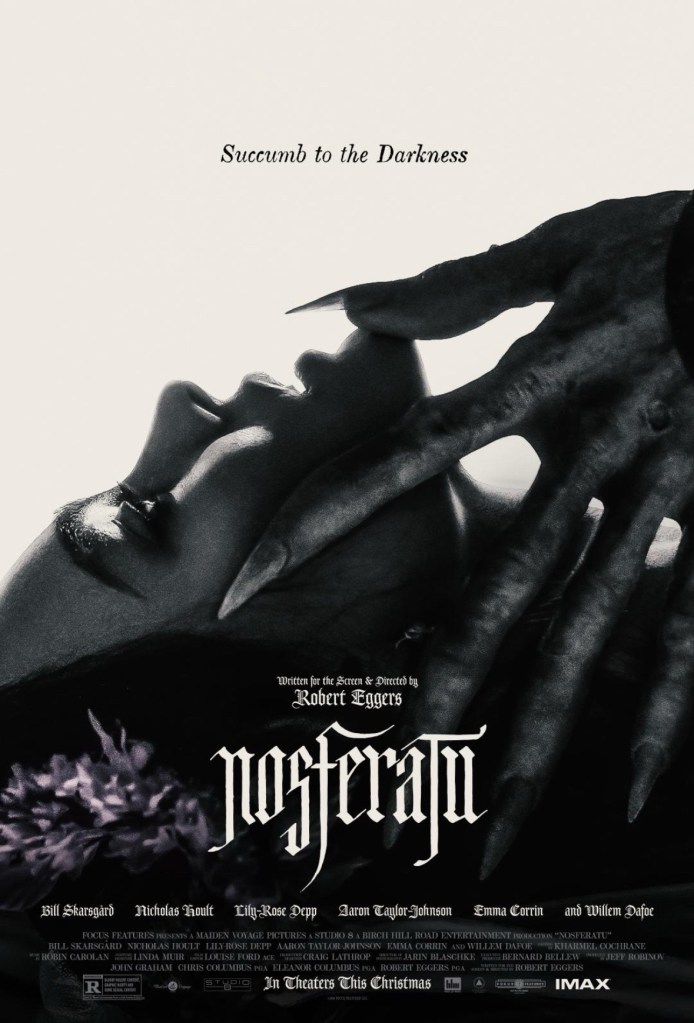
I read online that Nosferatu could be brutal on those suffering from misophonia. That is a strong reaction, or extra sensitivity to repetitive or sudden noises like loud gum chewing/smacking, sniffing, dripping water, dogs barking, a gate creaking, footsteps, and the like. I’d only heard of this condition less than a day ago, and I think I have it. Nosferatu’s sound design will certainly trigger it. These little sounds popping up bothered me more than the jump scares.
Director Robert Eggers was the man behind the camera for The Lighthouse, a film I really liked. It was basically a two-hander with Willem Dafoe and Robert Pattinson. It’s obvious that the same director’s hands are on Nosferatu, but ultimately, I was – at best – at arm’s length from everything. It looks great. It’s not in black-and-white, but sometimes I wasn’t sure whether it was. The cinematography is mainly drab, grey colors. The biggest giveaway that B&W wasn’t used was in the beautiful blue eyes of some of the actors, who, by the way, do among the stronger eye-acting I’ve seen. My autism spectrumy self has to force myself to remember to make eye contact, but not here. I was very drawn to them, in all their expressiveness.
Nosferatu comes 102 years after the silent film of the same name, which was inspired, of course, by Bram Stoker’s Dracula. Nicholas Hoult and Willem Dafoe have both dabbled in the cinematic vampire world before. It’s 1838 in Wisberg, Germany. Hoult plays Thomas, an estate agent who is sent on an assignment to sell a local home to a strange reclusive out-of-towner: Count Orlok. Thomas has to be gone for weeks, much to the disappointment and fear of his new wife Ellen (Lily-Rose Depp), who has been having increasingly disturbing nightmares. Orlok is a you-guessed-it. Enter a scientist halfway through, played by Dafoe, and it devolves into a parade of snow, screaming, bleeding, sweating, unusual facial hair, and a generous dose of movie character possession.
Orlok is played by Bill Skarsgård (Pennywise from the 2017/19 It movies). It doesn’t look or sound like him. His appearance, kept a secret in all the marketing, is definitely unique. I’ll just say he’s tall and anatomically correct. I won’t spoil any other details, as much as I want to make fun of them. He speaks agonizingly slowly, in a low rumbling voice. I would not want him to read War and Peace to me. He sleeps in a coffin surrounded by sharp objects – I guess, for the convenience of people who want to attempt to kill him, which he thwarts by suddenly jumping up and attacking at the last split second.
The final scene has a case of unfortunate timing that is almost at the level of Romeo and Juliet. The ending isn’t belabored. It errs on the side of being too abrupt, but by then, I was just happy they put a stake in this pain in the neck of a film. It’s a triumph from a technical and style standpoint, but I didn’t care about any of the characters, and had no interest in what happened to anybody. Once I realized my apathy, there was nothing to do but sit back and let it run its course. With each moment that continued to draw on, what worked so well towards the beginning lost its effectiveness, everything wore thin, and just like that, I was cured of my misophonia.
Grade: C
 Film Reviews by Mark
Leave a reply to 28 Years Later – Film Reviews by Mark Cancel reply