Grade: C
I love telling my Angriest Man in Brooklyn story.
8 years ago, I was on a huge Robin Williams kick. Within a month or two, I caught up with 10-15 titles throughout his filmography that I’d never seen, focusing on his latter day and/or lesser known work. The Angriest Man in Brooklyn, out in 2014, was one of his last. It’s crazy in so many ways. It’s from the director of Field of Dreams and Sneakers. Mila Kunis plays Williams’s nurse. Peter Dinklage plays his brother. Melissa Leo plays his wife. There’s one or two-scene cameos from Richard Kind, James Earl Jones, and Louis C.K. I really didn’t like it, but I’ve seen it twice. I chose to watch it again, because I was so fascinated by how consistently it manages to fail, even when succeeding would have been the path of least resistance. Every time I thought “they can’t screw this scene up, can they?” – they do. I almost recommend it, because it’s such a weird, unique unicorn of a movie. I wondered if I’d ever come across another Angriest Man in Brooklyn.
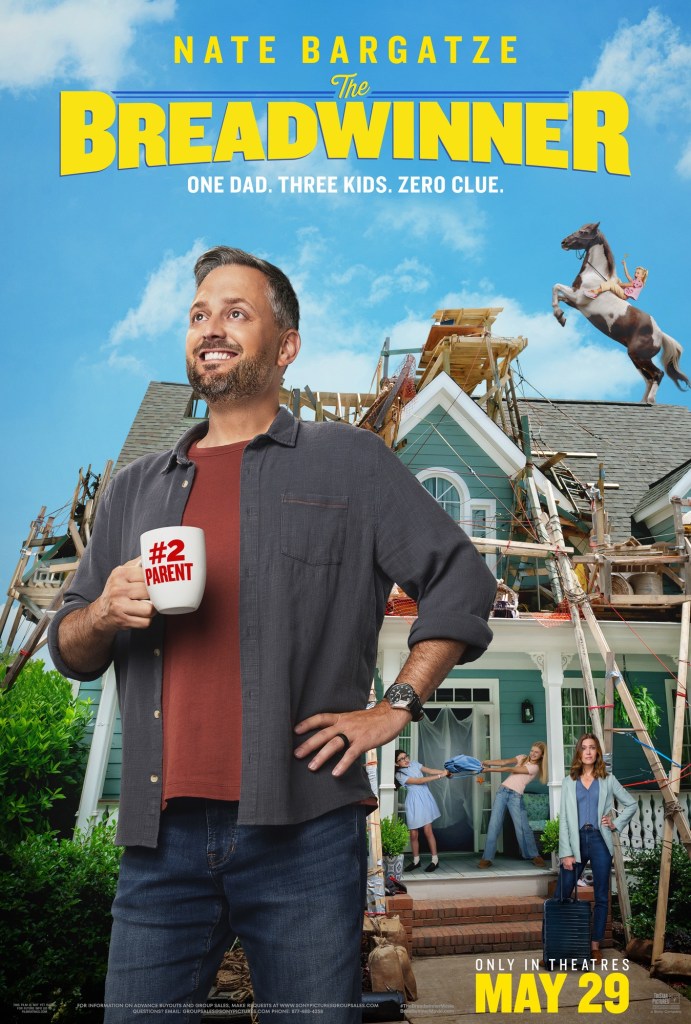
I found it, with The Breadwinner. The dialogue is unnatural and had scenes that reminded me of something you might see in the worst plays that were presented at the first community theater I ever performed at. Almost all of it is played for cheap laughs which should be funny in and of themselves, but by that point, I was either too frustrated with the movie, or the punchline could be predicted a mile away. These thoughts were copied and pasted from my original post about The Angriest Man in Brooklyn. The shoe fits once again. For the same reasons, I almost recommend The Breadwinner, but not in a weekend that also saw the releases of Backrooms and especially Tuner.
The Breadwinner takes a talented stand-up comedian and throws him into a movie that is based on many of his onstage bits. The results are horrible. Nate Bargatze’s act is squeaky clean, but never feels dumbed down or “kiddy.” He could perform it in churches. He makes Brian Regan look like George Carlin. His monotone Tennessee drawl makes the things he says funnier than they already are. On his next tour, he should open his show with “Uh, by the way, sorry about The Breadwinner.” I can hear his voice in my head saying that.
He plays Nate Wilcox, a successful car salesman who has won Salesman of the Year six times. His wife Katie (Mandy Moore) is the stay-at-home mother who tends to their three daughters with precision. As much as I’ll dog this film, I liked Nate as a character. We never see him use alcohol or drugs. The worst thing he says is “shoot,” even when the roof caves in or he’s just been thrown off a horse. When he receives positive attention from attractive elementary school teachers or moms of classmates, he never takes any of that to the next level. He’s so supportive of Katie that he doesn’t hesitate to take a leave of absence from his job at the dealership so she can follow her dream.
And she has one. An invention idea gets her on Shark Tank. The Sharks are ruthlessly brutal to Nate, when he’s unwittingly dragged on to the set, with no opportunity to finish his donut. This almost dashes her dream, but Lori Greiner (playing herself) agrees to be “in,” which results in Katie flying to South Korea for two weeks. This makes Nate Mr. Mom, and it ushers in scene after scene of mishap after mishap. He doesn’t think to plug in a toaster. He throws hard raw spaghetti sticks back into the cabinet and closes it quickly, hoping for the best. All the spaghetti sticks in the world rain on him the next time he opens it. Granted, this may have been an exaggerated fantasy sequence, but it’s hard to tell in a film like this.
I was going to say that a smarter next step for Bargatze would have been trying his hand in the sitcom world with this material, but I think I’ve put my finger on what would have improved The Breadwinner the most. It should have been a cartoon. I liked Adam Sandler’s Eight Crazy Nights. What plays so lamely in live action would likely be endearing as animation. It worked for the Sandman. How adorable would an animated Bargatze have been?
Come hell, high water, high sharks, or high horses, it forces its way to the happiest ending possible. Clips from Bargatze’s act, which were inspirations for the plotlines, play during the end credits. It finally concludes with so many clips from the very end of his specials, where he’s thanking everyone for coming out. It’s easy to take that as him profusely thanking us for attending his movie. The desperation is strong.
Grade: C


Leave a Reply