Grade: B
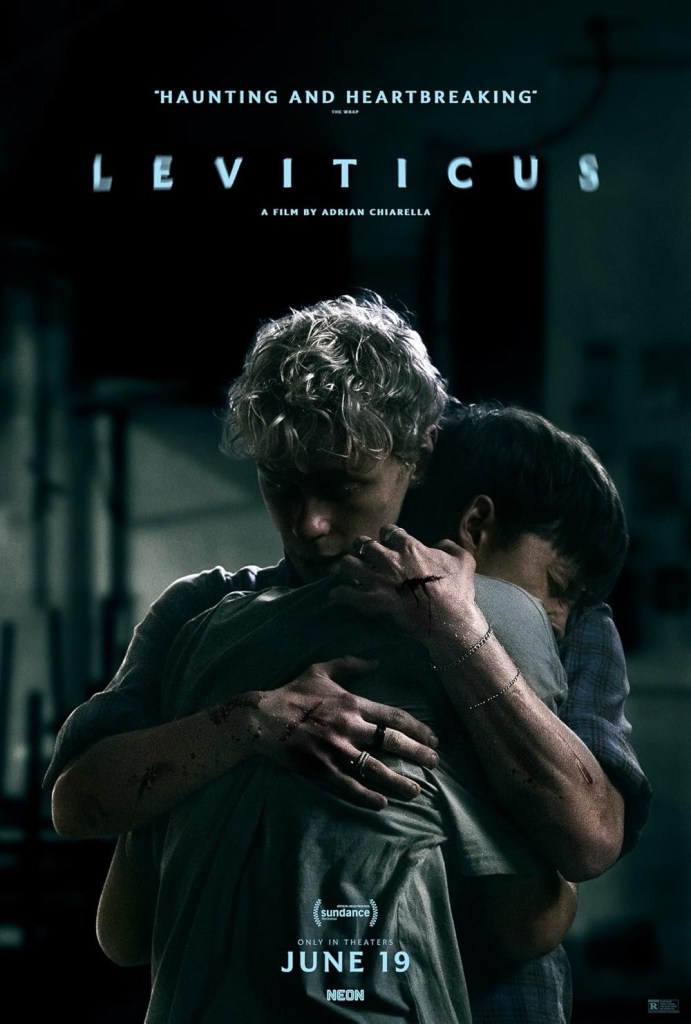
Leviticus is a smorgasbord of vibes, influences, connections, and ideas. It’s a ghost story about an entity, invisible to most, that latches on and is passed down. Smile is an obvious comparison. It takes place in a small, quiet, sleepy town and has an indie filming style, like Of an Age or Palm Trees and Power Lines. The third book of the Bible plays a large part, particularly in its exploration of an unpopular view of same-sex relationships. Joe Bird (Talk to Me) stars as Naim, a character who is attracted to men. Somewhere, there’s a critic who won’t be able to resist using “Call Me by Your Naim” as a headline.
It opens with a traditional horror cold open. A lifeguard at a public indoor pool is preparing to lock up for the night. The shower turns on by itself. No one is visible, but she senses something, asking, “What are you doing here?” She enters the shower, what follows begins intimate and quickly turns violent, and we don’t see her again.
We then meet Naim, recently relocated to an isolated, religious rural town in Australia with his mother Arlene (Mia Wasikowska). Naim begins a secret romance with Ryan (Stacy Clausen), but later sees Ryan kissing another teenager, Hunter (Jeremy Blewett). In jealousy, Naim outs them to the local church, which responds by forcing the two boys into a cult-like cleansing ritual.
The next time Naim ventures into Ryan’s backyard, he spies Ryan alone, talking to and embracing nobody. The presence of a creaky metal rotating laundry clothesline provides both scenes with eerie efficacy—as towels and garments pass through frame, creating a slow strobe effect as they intermittently obscure the action.
The movie advances its plot steadily, but takes time to reveal what it’s actually doing. Its first half sits in familiar indie slice-of-life territory, to the point where it risks feeling intentionally evasive. After Naim undergoes the same cleansing ritual, he begins experiencing the same phenomenon. Victims—exclusively the film’s queer characters—start seeing hallucinations of the people they’re attracted to. The presence appears harmless at first, even intimate, before turning violent. Some characters resist it, others don’t survive.
Once the premise locks into place, Leviticus becomes a sharper blend of dread and dark comedy. As Naim and Ryan are both affected, and begin seeing versions of each other, their real-world interactions become cautious and uncertain. There’s a very funny line where Ryan tells Naim, “If you see me again, stay away. It won’t be me.” It’s humorous in its oddity, and heartbreaking in how it signals the distance growing between them.
The symbolism becomes clear. It’s a metaphor for fear. There’s no tangible way to permanently stop it, but if you’re lucky, it won’t kill you. That’s ultimately where Leviticus lands: a smart, unsettling idea stretched across an uneven film, most effective when it finally stops circling its premise and starts engaging with what it actually means. It’s compelling in bursts, frustrating in its hesitation, and strongest once it stops being coy and simply confronts the fear it has been building toward all along.
Grade: B


Leave a Reply