Grade: B+
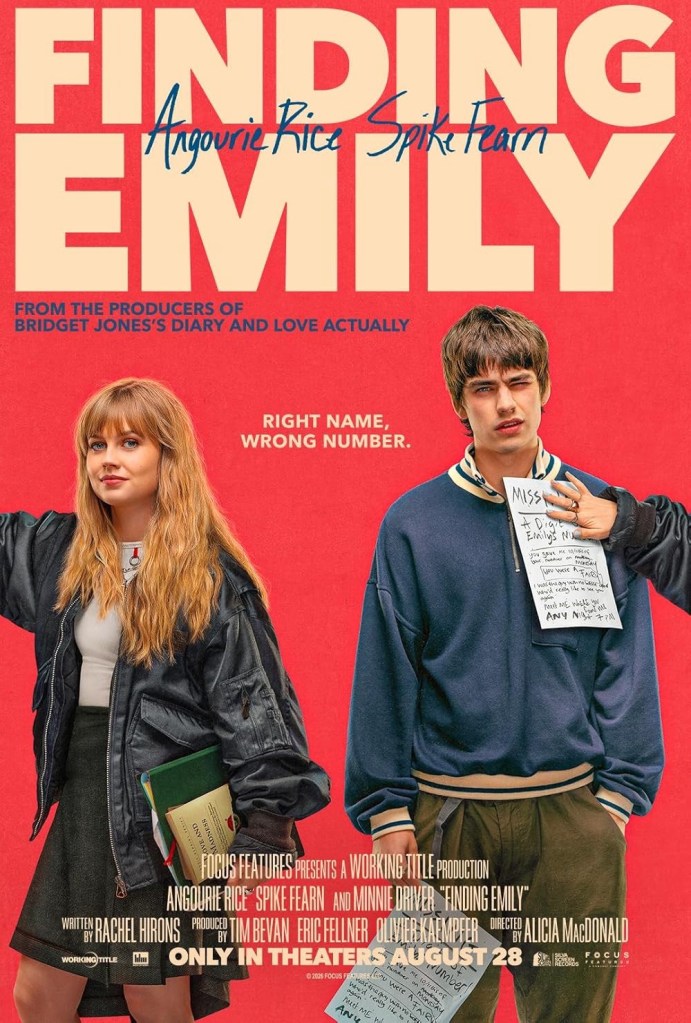
Finding Emily throws practically every romantic-comedy cliché in the book at us – yet it possesses enough sheer charm to overcome them. It has heart, offers smart observations about the human condition, and is carried by two enormously likable lead performances.
The plot follows Owen, a sound engineer at a student bar at Manchester City University. One night, he meets a girl while working, and they immediately hit it off. The evening even builds to an Almost Kiss Moment before her friend interrupts, reminding her they have a birthday party to attend. In the rush to leave, Owen manages to get her phone number and her first name: Emily.
The next morning, he discovers the number she entered is missing a digit. He knows she attends the university, but otherwise all he has to go on is her first name and a vague description. Owen is smitten and determined to find her. I can identify with that kind of one-track-mind mentality. It’s easy to let those thoughts snowball into: “I had one great night with the girl of my dreams, and I have to find her, or she’ll become the one that got away.”
Not long afterward, we meet psychology student Emily Raine, an American studying abroad. She’s not “Owen’s” Emily—just one of the 300-plus Emilys enrolled at the university. Emily is working on a psychology thesis that could land her a prestigious job and allow her to remain in England. The thesis argues that romantic attachment may be an “evolutionary hangover.” As she puts it: “Do we really love the people in our lives, or are we simply in love with our projections of them?”
It’s a clever setup because the film immediately gives us two competing ideas of love: Owen believes in destiny, while Emily is trying to prove that destiny is an illusion. Unsurprisingly, Owen’s search for “his” Emily makes him a perfect case study for her research.
At Emily’s suggestion, Owen emails every Emily enrolled at the university asking if she’s the one he met. Unfortunately, he makes the critical mistake of sending it as a public email instead of BCC, and only realizes it after the replies start flooding in. He becomes “Email Guy” almost overnight, as the situation spirals into a campus-wide phenomenon. Montages show the story exploding across social media, and his podcast interview is livestreamed seemingly everywhere—including students gathered outside in the quad.
It’s one of those movie conventions where a single event becomes the only thing anyone can talk about, as though the rest of the world has stopped. Fortunately, Finding Emily knows exactly what it’s doing. A frustrated extra eventually blurts out, “How is this still happening?” – and the joke lands because we’re thinking the same thing.
Naturally, there comes the point where Emily’s true motives are revealed, leading to the obligatory falling-out between the two leads. That’s followed by another genre staple: a montage of them sulking separately while a melancholy song whines on the soundtrack. Finding Emily doesn’t reinvent any of that.
What’s more interesting is what the film eventually does with the real Emily. Once she reenters the story, the explanation for why she never responded to Owen’s infamous email is surprisingly grounded, and their reunion unfolds in a way that feels genuinely less predictable than expected. The movie can’t resist familiar romantic-comedy beats, but every so often it finds small detours that keep things from feeling entirely predetermined.
Many viewers will recognize Angourie Rice (Emily Raine) from 2024’s Mean Girls. If that film introduced her to a wider audience, this confirms she can carry a movie. She has a magnetic screen presence, as does Spike Fearn as Owen. It’s also nice to see Minnie Driver in a small role as the university dean, along with Sadie Soverall (Saltburn) as THE Emily.
The finale came surprisingly close to knocking the film down a grade. Roger Ebert often referred to this as the Dramatic Late Arrival: a key character appears during a speech or presentation, and somehow the speaker instantly spots them in the back of the house. Finding Emily doubles down by having the ensuing conversation continue outside, where a conveniently placed lapel microphone picks up every word.
Fortunately, the film makes two smart decisions. First, it undercuts the moment with another self-aware joke, as someone in the audience sighs, “Oh no, we’re gonna hear the whole thing.” Second, it knows exactly when to stop. After delivering the final emotional beat we’ve been waiting for, and knew was coming, it cuts straight to the credits instead of lingering through an unnecessary epilogue.
You’ve seen this movie before – but in many ways, it still feels like you haven’t.
Grade: B+


Leave a Reply