Grade: C
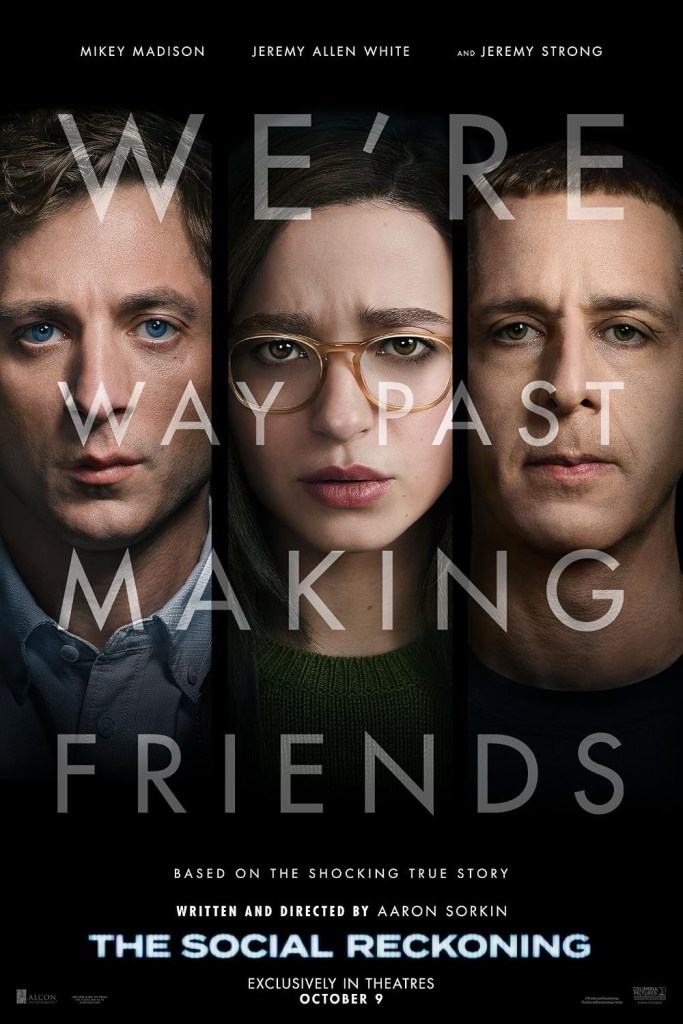
Remember being a kid, walking in on a party your parents and their friends were having, and catching a couple minutes of a movie they were watching? “There’s so much talking and big words, and no action. How can anyone be entertained by this?” The Social Reckoning made me feel like I was that age again, wandering into a boring grown-up movie. It’s a thriller for the brain, rather than the heart or the soul. I thought of A Civil Action, The Insider, She Said, and Conclave. People might object in a courtroom, find documents that were stashed away, or huddle around a computer to psych themselves up to click “publish.” Those activities are the height of the thriller. I can’t get too excited by them.
I wasn’t doing full length reviews when I saw The Social Network in 2010, but I’ve always been coming up with grades in my head, and I landed on B+. A few days ago, I rewatched The Social Network in preparation for The Social Reckoning. The B+ stands. It’s unmistakably an Aaron Sorkin screenplay (a fact that doesn’t always work in his favor), but it’s a movie that breathes—with peaks and valleys. It works despite, and in many cases because of its Sorkinness. It helps that it’s about a character’s personal journey, not just his professional one. The Social Reckoning is stripped of the personality that made The Social Network so riveting and endearing. It’s all professional business.
I loved the opening scene. It made me optimistic that lightning would strike again. It’s a commentary on how social media is used to distort narratives and perceptions. Viral videos that show a confrontation tend to start in the middle of the incident, making me wonder what was happening right BEFORE they took out their phone and started filming. Here, we see everything.
A blonde white woman is standing by the side of the road next to her overheated car, waiting for the tow truck. She is intoxicated, but thinks she’s in the clear, because nobody stopped her while she was driving, and she’s not driving anymore. Two officers (a man and a woman, both people of color) stop to make sure she’s ok. They are extremely nice and professional, but understandably ask if she’ll perform some field sobriety exercises. She doesn’t take kindly to it, and begins live-streaming, claiming these officers were getting in her face and persecuting her because of her race. We got the whole context. The internet gets the version of the story she chooses to present.
After beginning with that burst of life, the film quickly squanders that goodwill. It soon devolves into Sorkin-as-lecturer territory. Endless dialogue about internal documents, reshares, flash drives, likes, and all the other things that apparently constitute a high-stakes thriller in the world of social media. At one point, Bill Burr talks about commoditizing gullibility. Sounds like we have a name for his next Netflix stand-up special. Bill Burr: Commoditizing Gullibility. You’re welcome, Bill.
It’s a lot of blah blah blah and verbal fireworks, but there’s no personality or heart to make all that talking worthwhile. Actors I like very much are wooden and mechanical. It’s mostly Jeremy Allen White (at his most boring, or rather, the first time I’ve ever been bored by him) and Mikey Madison. She plays the Facebook whistleblower Frances Haugen, who feeds information, off the record, to White as a Wall Street Journal reporter. She’s so paranoid about being discovered that she wears nice, low-cut dresses every time she meets him at his hotel room. She figures that if anyone she knows or works with sees them together, she can just say she’s on a date. A romance never develops between them, but there was a part of me that was HOPING it would. At least then the movie would finally give us something, even if it was a cliché.
Betty Gilpin (The Hunt) and Wunmi Mosaku (Sinners) are wasted in their roles. There are good actors here, but the movie doesn’t give them much of a chance to be interesting. Everyone seems to be in service of the information they’re delivering, rather than playing people with personalities, relationships, and lives outside the latest document or revelation.
Jesse Eisenberg declined to reprise his role as Mark Zuckerberg because he didn’t want to be pigeonholed. At first I was disappointed by that, but turns out it doesn’t matter much, because Zuckerberg doesn’t have much screen time. Plus, Jeremy Strong is perfectly fine and successful at continuing the character.
That’s not the problem. The problem is that The Social Reckoning doesn’t give us the same compelling personal drama that made The Social Network work. The first movie wasn’t just about a guy building a company. It was about who he was, what he wanted, the people he hurt, and the relationships he couldn’t seem to get right. The professional story mattered because it was inseparable from the personal one.
Here, Sorkin still has the rapid-fire dialogue, the big ideas, and the people explaining complicated things to one another at great length. But the very qualities that make his style endearing when everything clicks can become exhausting when a movie gives you too little reason to care about the people doing all that talking. The Social Network made all that talk entertaining. The Social Reckoning makes it feel like homework.
I went into The Social Reckoning hoping to recapture some of the magic of The Social Network. Instead, I got a movie that makes important points about social media but never makes the process of watching it particularly enjoyable. I guess the grown-ups can keep watching. I’ll find something else to do.
Grade: C


Leave a Reply