Grade: A
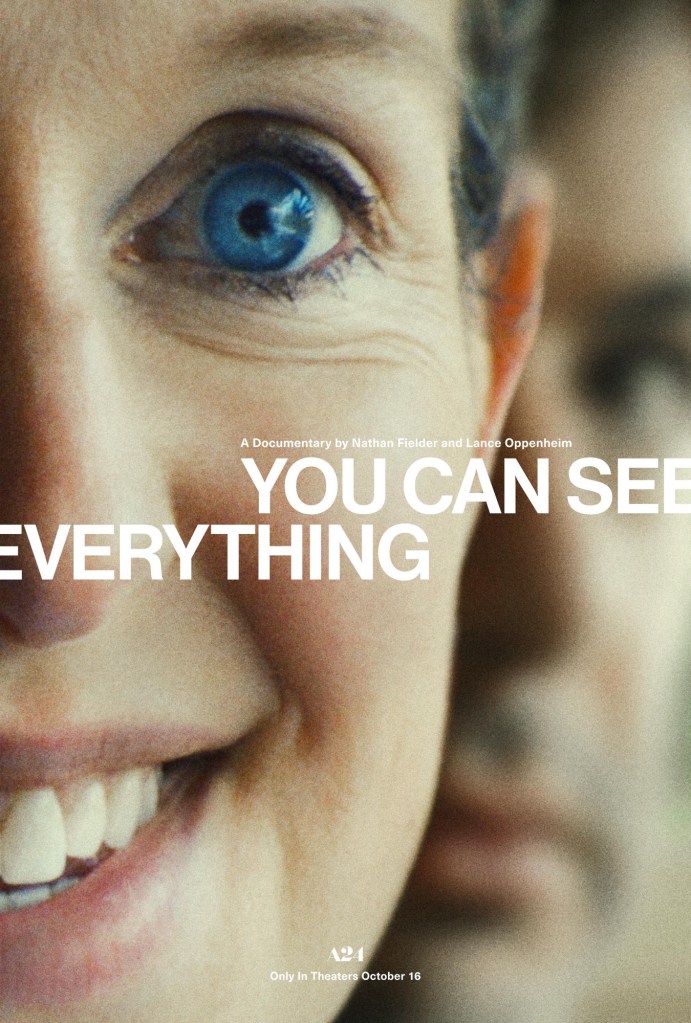
The subject of You Can See Everything is 42-year-old Elizabeth Holmes, the founder of Theranos. She is currently serving an 11-year prison sentence for defrauding investors. You don’t have to know any of that to appreciate You Can See Everything. I’ve seen the movie, and I don’t think I learned anything about what she did and how. It’s an absorbing character study and an exploration of human behavior. It could have been an epic from Scorsese, Christopher Nolan, Paul Thomas Anderson, and the like. The documentary format makes it all the more remarkable that we’re watching real people be themselves. I liked it better than Oppenheimer and Killers of the Flower Moon.
It’s co-directed by Nathan Fielder and Lance Oppenheim. The latter, who most recently directed Primetime just a few weeks ago, mainly stays behind the camera. We see plenty of Fielder, as he has been invited to live with Holmes and her partner, Billy Evans, for the month leading up to her turning herself in to serve those 11 years. She believes she is innocent and has done nothing wrong, so she’s pulling back the curtain for the documentary crew. The film’s title comes from her demonstration of transparency.
Holmes has big blue eyes and is often smiling, even when the smile shouldn’t match the tone of the interaction. She speaks with a calm, almost vacant cadence. Fielder is deadpan most of the time, but shows his exasperation when Billy tells him he knows how Fielder feels when it comes to the nature of conversations with Elizabeth. He snaps back with “No you don’t!”
The boyfriend, Billy Evans, is a piece of work. I’d nominate him for an Oscar if it were possible. It’s easy to forget that this is a documentary with actual people. It was vindicating to see a certain caption about him at the end. Fielder, at one point, plays Abbott and Costello’s “Who’s on First” routine for Elizabeth and Billy, to show how the circular dialogue in that bit mirrors the conversations with Elizabeth. When she doesn’t get it, or gets it in her own way, we wonder if she’s for real or the whole world is being played.
We stop seeing Elizabeth halfway through, as she begins her prison sentence. Fielder stages reenactments of significant conversations that he either didn’t or couldn’t film. Somebody I wasn’t expecting to see enters the movie and becomes an enormous part of this second half. Again, I was wishing it were feasible for an acting nomination to be doled out. The movie is doing so many things I can’t talk about here. It’s a rabbit hole of layers upon layers that brought to mind at least two titles from Charlie Kaufman’s filmography.
See this in a packed house, if you can. The gasps, laughter, and other reactions will add to the experience. And there is a lot of funny stuff. Fielder has a skill for building up to a comedic payoff, whether through extended silence or through a transition where the first line of the next scene is a punchline for what we just saw.
If you haven’t come any closer to understanding Elizabeth Holmes or this situation, don’t feel bad. Fielder himself is stymied and has been practically begging attendees at Q&As to “please help me make sense of this.” You Can See Everything is a triumph that will ruin documentaries (and several straightforward regular movies) for a long time. I was captivated. Don’t let the 2-hour-and-54-minute runtime scare you. I was disappointed when it was over and could have watched another couple of hours. It has all the elements of the greatest character-driven thrillers. The fact that it’s real makes it all the more eerie.
Grade: A


Leave a Reply