Grade: B
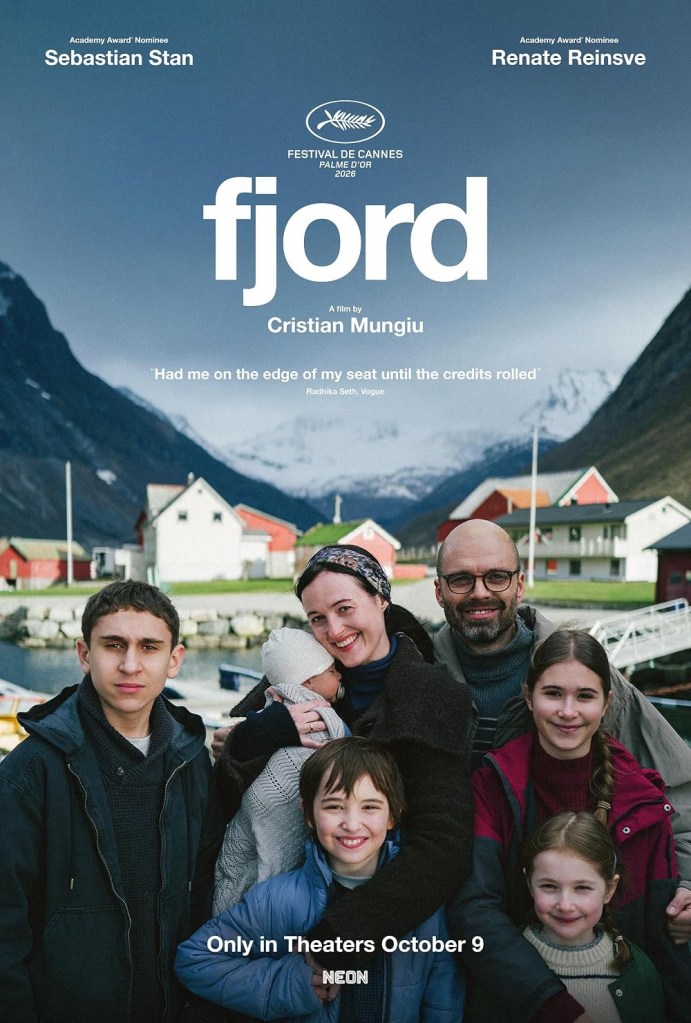
Fjord feels tailor-made for the Oscars. It’s long, it stars two Academy Award nominees, it has sociopolitical undertones, and it’s coming out at the prime time of the year for awards consideration. We’ll be hearing about it for the next several months. It will not make my top ten list at the end of the year, but I hope it gets a Best Picture nomination. There’s a difference between loving a movie enough to put it on your “personal best” list and hoping it’s in the conversation during awards season.
Fjord is such an ensemble movie that it would feel weird to see any individual performance singled out with an acting nomination. But everyone is believable and never upstages anyone else. The cast works together. The first half hour doesn’t have any major plot to latch onto. It’s all about this family of seven moving to Norway, starting at new jobs and schools, meeting people, and participating in social activities. It’s a great slice of life. I would have been fine if the whole movie had been like that. A film doesn’t need a big plot to hold my attention, provided the people and their everyday experiences are compelling—and they are. The locations, situations, general charm, and all the filmmaking elements were enough to carry it through and keep me invested.
The parents are played by Sebastian Stan and Renate Reinsve (Backrooms, Sentimental Value). They are devout evangelical Christians, strictly but lovingly pressing their children to study the Bible and pray frequently. A teacher notices bruises on one of the children and brings the child into the office to ask about them. The adults interpret the kids’ answers as confirmation of abuse from their parents, and Child Welfare Services becomes involved, placing all five children (even the baby) in foster care.
Stan and Reinsve can’t help but wonder if this is a form of religious discrimination. They all did their share of proselytizing, after all, whether it be with their new friends, coworkers, or classmates. There is also, perhaps, a language barrier here. Words mean different things in different places. A “slap” to some is a malicious, violent act—or it could mean a simple pat on the butt. They may see it not as an attempt to cause pain, but as a physical expression of disapproval when a child misbehaves.
By this point, the plot is relying on a misunderstanding that, it seems, could easily be clarified, but instead, becomes national news and a courtroom drama. You could call it To Spank a Mockingbird. Still, I give the movie credit for making this family’s predicament feel consequential, even when the circumstances driving the story become increasingly frustrating. The performances remain grounded, and the film gives us room to understand how both sides see the situation, even if that understanding doesn’t necessarily make their positions equally convincing. For all my reservations about where the story goes, I remained invested in the family and curious about how it would all play out.
Roughly half the movie is in English, and the other half is in Norwegian, with English subtitles throughout. Sometimes the language switches back and forth within the same scene. The captions serve different purposes, translating the Norwegian dialogue when necessary and helping us follow the conversation even when everyone is speaking English. It’s a neat approach that could easily have become distracting, but it flows remarkably well. I stopped noticing the language changes pretty quickly, which is probably the best compliment I can give it.
The last few seconds of the movie are bonkers. Something happens that’s a callback to a moment from much earlier, then it abruptly cuts to black. After almost 2 1/2 hours of serious family drama, this is how they choose to end it. I audibly went “Ha!” I’ll remember it, that’s for sure. Fjord is an imperfect but engaging film, with a terrific ensemble and enough interesting ideas to keep the conversation going long after the credits roll. I liked it, even if I didn’t love it, and I hope you see it. It’s the kind of movie that invites discussion, and I suspect different viewers will come away with very different interpretations of what they’ve seen.
Grade: B


Leave a Reply