Grade: A
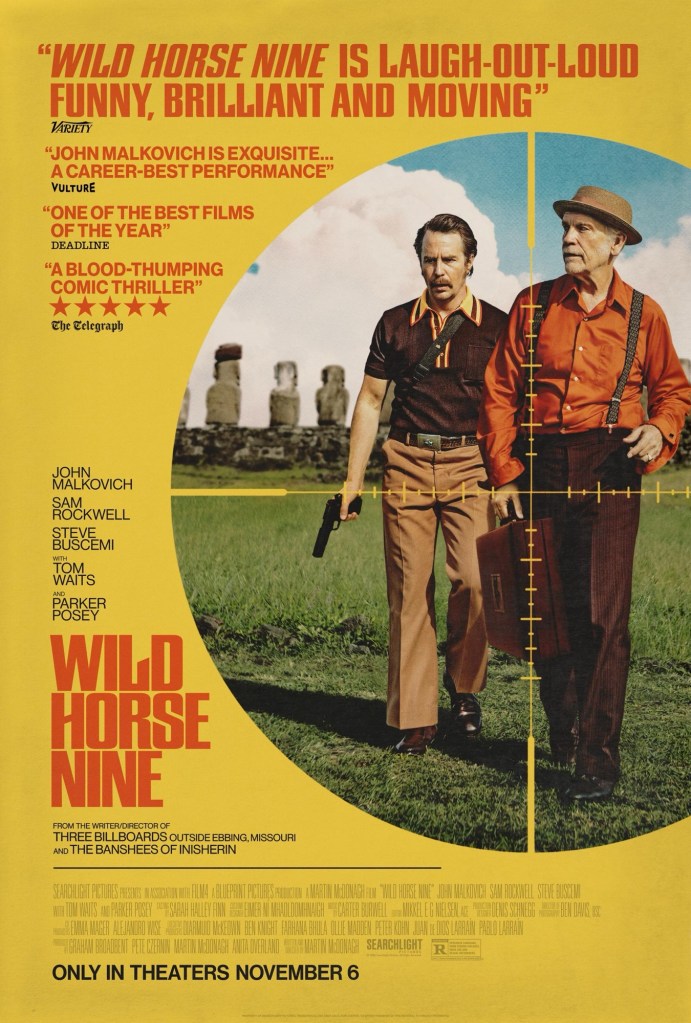
For at least the second film of his in a row, writer/director Martin McDonagh has planted a hauntingly beautiful line that gets under my skin in all the good ways, and sticks with me. In The Banshees of Inisherin, it was “There goes that dream,” said by a character immediately after being rejected by the woman he had a crush on. In Wild Horse Nine, McDonagh’s fifth feature film, John Malkovich has just walked back to his friend and work partner after having a pleasant conversation with a woman on the beach. He says, “She is life, and I’m leaving it.”
Malkovich’s character, Chris, is dying of cancer. He was given six months six months ago. He had always wanted to “see the heads” at Easter Island, which is a short trip from Santiago, where he and his partner Lee had just been, on an assignment. Chris and Lee are CIA agents. It’s 1973. There was a lot going on in Chile in 1973, and the movie could have bogged us down with the obligatory action-spy-thriller business, but it doesn’t. It’s more about relationships, friendships, redemption, and making the most out of the present moment with the remaining time you have.
I may have just made it sound like a drama about a dying man trying to fulfill a bucket list. It doesn’t really veer into that territory either. Wild Horse Nine is a movie that feels tailor-made for me and my weird little brain. It is darkly funny, chock full of dialogue that would have been at home in The Odd Couple or Planes, Trains & Automobiles. But pigeonholing it with even that description feels reductive. The screenplay has the kind of arcane tangents and associations you aren’t likely to find anywhere else.
In a typical dark comedy, someone saying “I’ve killed people in countries you can’t even spell” might be the final button before the subject is changed. But in a McDonagh script, the claim gets challenged. “Name one country you’ve killed someone in that I can’t spell.” Another time, Lee has a most unique reason to suspect that Chris has a bomb in his hotel room. And in yet another instance, Chris assumes something about their boss’s lifestyle, and Lee laughs it off, saying that’s not true. The audience finds out that it is true, and when Lee does later on, he tells Chris he was right. Chris’s response is essentially: “No way, really? I was just messing around when I said that.”
Said boss is MJ, the CIA bureau chief, played by Steve Buscemi. This is the third time in eight days that I’ve seen Buscemi (after Klara and the Sun and The Only Living Pickpocket in New York), and he has a larger role and is better in each one. His portrayal of MJ calls back to choices he made that worked very well when he was Mr. Pink in Reservoir Dogs. He harps on about “being a professional,” and I was struck by his use of the word “man” in the middle of an angry rant. It seemed to be saying, “I’m sorry I’m yelling at you right now, but I just want you to see where I’m coming from.”
MJ wants Lee to keep an eye on Chris. The brain fog associated with Chris’s condition has caused his tongue to get looser and reveal more information about their profession than he should. Plus, MJ is concerned about exactly how tell-all Chris’s memoirs-in-progress are going to be. This is the best I’ve ever seen Malkovich, including when he played himself in 1999. He’s not just a cute, funny, doddering old man with a terminal disease. He’s allowed to have other levels, and is scary when he gets upset.
His rapport with Sam Rockwell as Lee is the best chemistry between two actors that I’ve seen since Leonardo DiCaprio and Brad Pitt in Once Upon a Time in Hollywood. Rockwell isn’t just a co-star overshadowed by a showy lead. With his line deliveries, phone calls home to his wife (Parker Posey, also wonderful), and unspoken reactions to Malkovich’s musings, the amount of heavy lifting Rockwell does shouldn’t be forgotten about. Tom Waits is effective in his one scene as a man who knows Chris in a way I’ll leave you to discover.
The locations are breathtaking, and worth seeing on the big screen. An action element does come into play near the end, but it never feels like autopilot. The final moments made me think of a famous John Steinbeck work. As usual with me, it brought up questions about what will happen next, and how, but I didn’t need those answers. It was enough to take in what was happening in the present moment.
Wild Horse Nine is a triumph on its own, but it’s also made me appreciate McDonagh’s work as a whole in a new way. Having now seen three of his five feature films, I found myself recognizing connections to both Three Billboards Outside Ebbing, Missouri and The Banshees of Inisherin, and came away feeling like this was another chapter in an ongoing conversation he’s been having throughout his career. Now more than ever, I want to go back and catch up with his first two features, In Bruges and Seven Psychopaths. It’s a wonderful thing when a filmmaker can make a movie this satisfying while simultaneously making you more interested in everything that came before it.
Grade: A


Leave a Reply