Grade: B
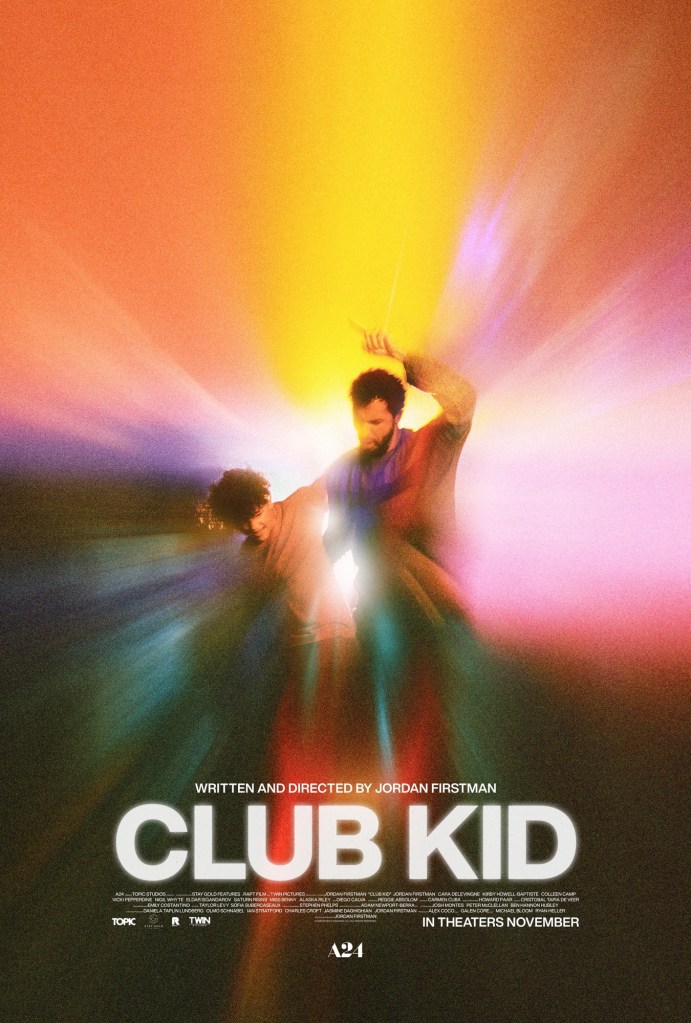
Viewers who go into Club Kid completely blind, not knowing anything about the plot, are in for one humorously jarring surprise. After the first half hour establishes our lead character as a drinking, drugging, clubbing night owl, his roommate knocks on his bedroom door and asks, “How much longer do I have to talk to this British lady who is here with your son?” There’s your exposition in one sentence. It might be my favorite setup of the year.
Jordan Firstman makes an impressive feature film debut as the director and sole writer. He’s also the star, as Peter, a hard-partying professional club promoter in New York City. He doesn’t remember ever having sex with a woman, but evidently he has, because he has a son, now 10 years old, that he didn’t know about. The mother has recently taken her own life, so the boy (Arlo), who grew up in London, is brought to the States to be raised by his dad he never met.
Critics and viewers are calling Club Kid “a gay Big Daddy,” referencing the 1999 Adam Sandler film. I can understand that comparison, to an extent. We get taken through some of the usual beats. At first, Peter tries to find a way to get rid of Arlo ASAP, but after realizing they’re stuck together, he grows to love his son and the situation. Of course, a third-act plot point comes into play, where Peter is told that Arlo will have to be taken away—and of course, what he wanted at the beginning is no longer what he wants now.
As a director, Firstman is able to find meaning in what might otherwise be filler sequences. I loved the slow 360-degree rotating camera shot inside a car, as an Uber driver transports Peter and his noisy group of friends from one club to another late at night. As an actor, he brings emotional texture and weight to moments that we’ve seen before and may feel cliched by this point. As a writer, he makes meaningful use of a supporting character played by the only actor I recognized: Diego Calva. Calva isn’t just dropped into the movie as a romantic love interest. He has other reasons for being there.
It doesn’t end in quite the way I predicted, or the way many would hope, but I wouldn’t call it a sad, negative ending by any means. It’s mixed, to be sure, but points toward optimism. The last scene with dialogue might be my favorite closing scene of the year. It’s perfect in its simplicity, and it’s all the more impressive when you notice it was done in one long take. Everyone in Club Kid is a better person than they were at the beginning. It’s not just a gay Big Daddy.
Grade: B


Leave a Reply